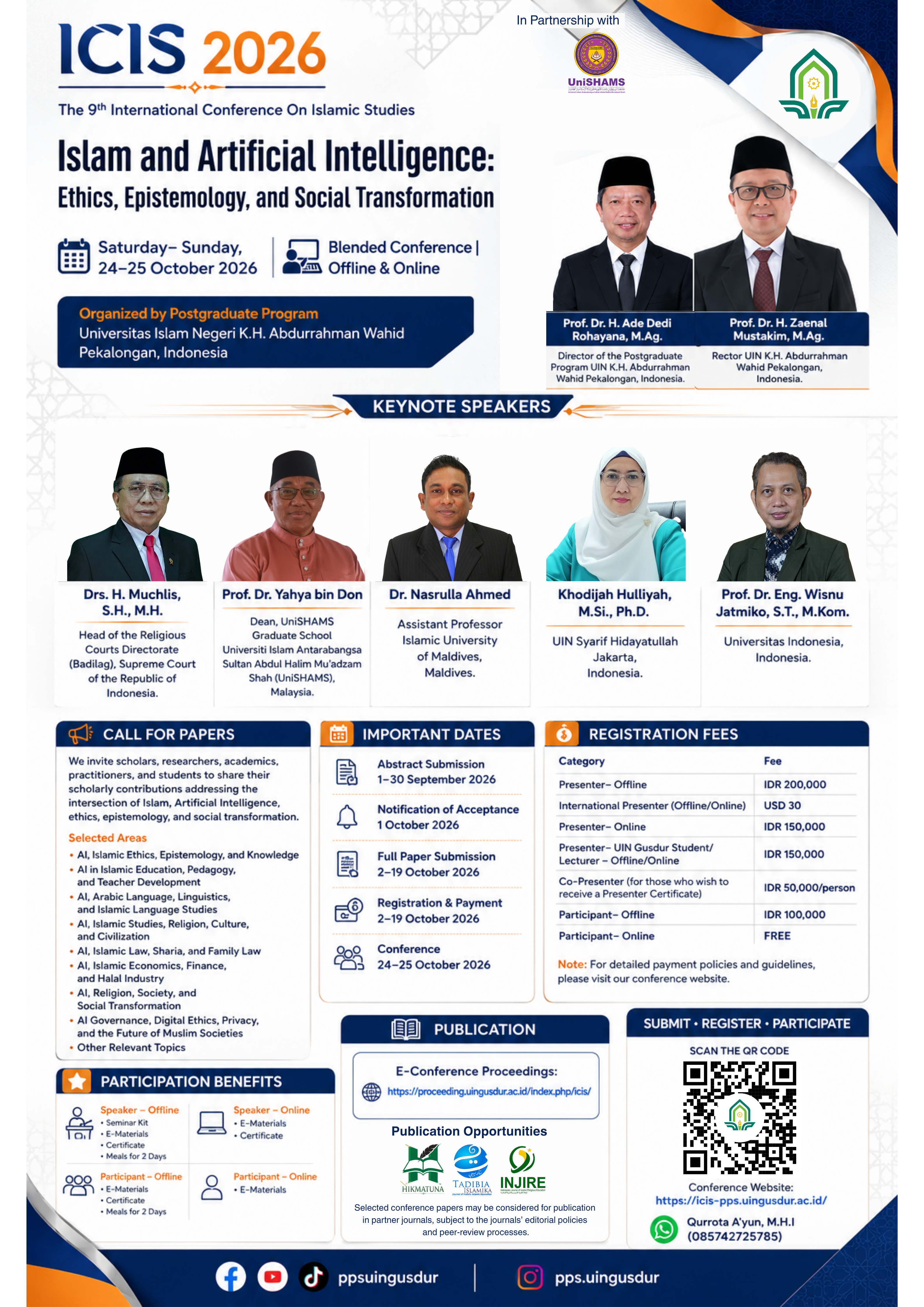
Beyond Cognitive Debt: Reconstruction Pesantren Pedagogy Bridging Hasyim Asy’ary’s Adab al- Alim wa al- Muta’allim and Generative AI
Kata Kunci:
generative AI, cognitive debt, adab al- alim wa al- muta’allim, pesantren pedagody, epistemic agencyAbstrak
The explosive proliferation of Generative Artificial Intelligence (GenAI) creates a significant dilemma for islamic education: while maximizing computing performance, uncritical dependence fosters heavy mental tool, superficial processing and forfeiture of intellectual autonomy . Concurrently, secular digital humanism reduces learners to datafied subjects evaluated through performativity metrics. To addres this crisis, study aimed to construct an integrative conceptual framework for Pesantren pedagogy by orchestrating a critical dialogue Hasyim Asy’ari’s classical treatise, Adab Al-alim wa al-Muta’alim. Employing a qualitative conceptual research design and hermeneutic analysis of primary classical texts alongside cognitive neuroscience findings, this study synthesized classical ethics with modern digital pedagogy. The results yielded the ‘Adab al-Lilm DenAI Matrix’, a seven- dimensional analytical model redefining learning ethics from passive compliance to formative moral development grounded in muraqabah and tazkiyat al-nafs. Furthermore, the findings conceptualized ‘cognitive friction’ and ‘digital fasting’ as core pedagogical mechanisms to safeguard student intellectual agency (jidd wa ijtihad) and systematic verification (tahqiq-tabayyun). Framed through Maqasid al-Shari’ah (Hifz al-Aql and Hifz al-Din), this study concludes that Digital Intelligence (KD) must function strictly as an instrumental tool (wasilah) subservient to Spiritual Intelligance (KS) ast the ultimate existential purpose (ghayah), providing a transformative theoretical paradigm for islamic educational institutions in the algorithmic era.