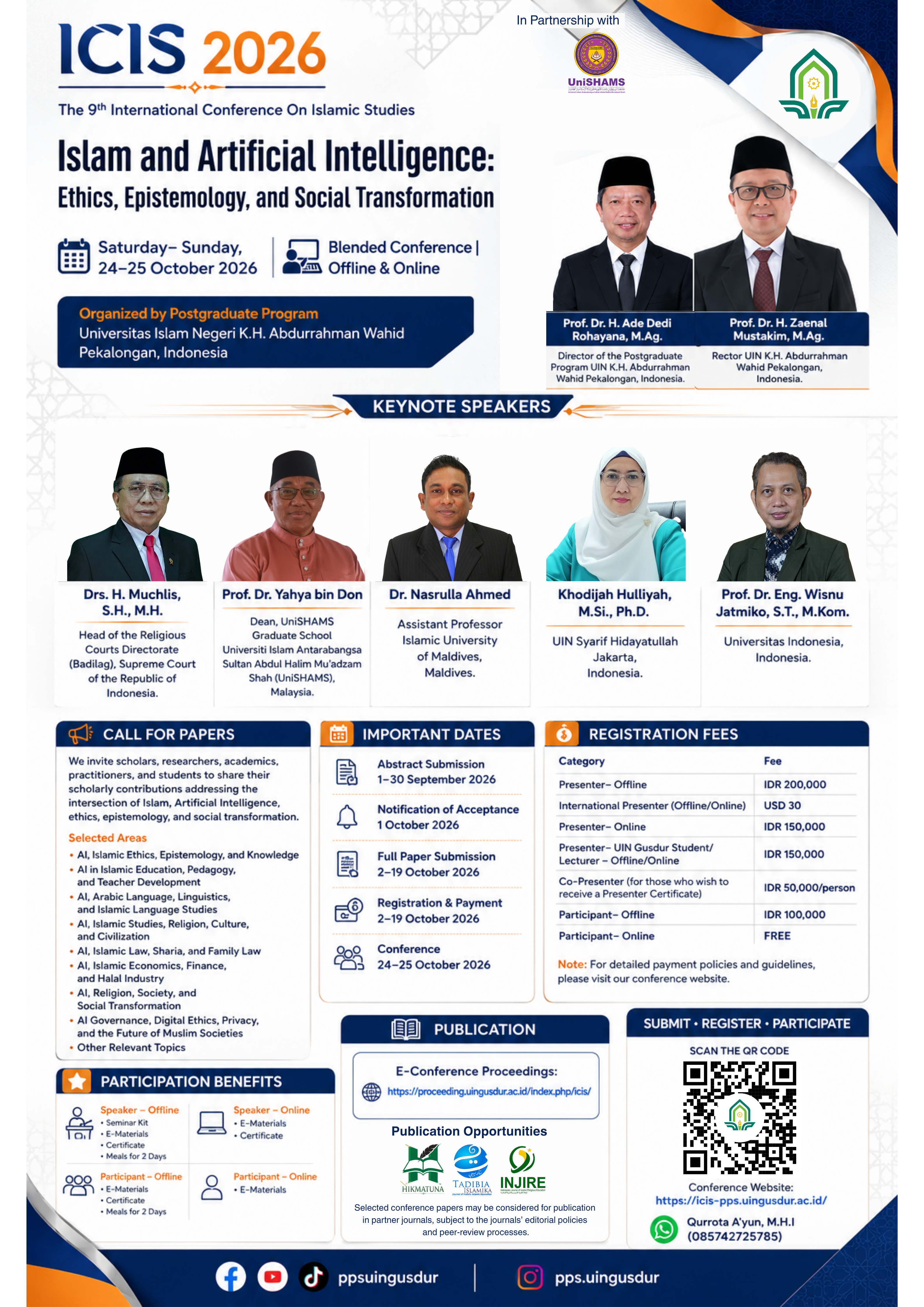
Islam and Artificial Intelligence: Ethics, Epistemology, and Social Transformation in the Era of Society 5.0
Keywords:
islamic ethics of AI, islamic epistemology, maqasid shariah, taqwa model, social transformationAbstract
Artificial Intelligence has become the most disruptive technological force in the 21st century, transforming the fundamental aspects of human life, from ethics, knowledge production, to social structures. While Western discourse has dominated the development of AI ethics frameworks based on secular humanism and utilitarianism, the perspective of Islamic civilization as a major worldview has been relatively marginalized. In fact, Islam offers a comprehensive and transcendent ethical and epistemological system that is highly relevant for guiding AI development. This article aims to construct a comprehensive Islamic framework for AI by examining three main dimensions: Ethics, Epistemology, and Social Transformation. This research uses a Systematic Literature Review SLR method with a critical-analytical approach to 67 primary sources, consisting of classical Islamic turats Al-Qur’an, Hadith, works of Al-Ghazali, Ibn Sina, Al-Farabi), contemporary Islamic thought Al-Attas, Al-Qaradawi, Tariq Ramadan, and contemporary AI ethics literature Floridi, UNESCO AI Ethics, MIT Technology Review from 2015-2026. The findings show that: First, from an ethical perspective, Islam offers five foundational principles for AI ethics that go beyond Western principles: Tawhid Unity and accountability to God, Amanah Trusteeship and responsibility, ‘Adl and Mizan Justice and balance, Maslahah and Maqasid Shariah Public interest, and Karamah Insaniyah Human dignity. Second, from an epistemological perspective, Islam distinguishes between ‘aql, knowledge by presence, and revealed knowledge, thus providing a critical view that AI is only capable of reaching the level of ‘aql juz’I partial reason and cannot replace al-‘aql al-kulli and qalb. Third, from the perspective of social transformation, Islam views AI not merely as a tool, but as a test ibtila’ and a means to achieve Falah and social justice, requiring reconstruction of education and economy based on Adab. This article offers a novel integrative model called the taqwa Model Tawhid, Amanah, Qalb, Wisdom, Adl as an Islamic Human-Centered AI framework. The conclusion asserts that Islam does not reject AI, but directs its development to remain within the corridor of Adab and humanization.