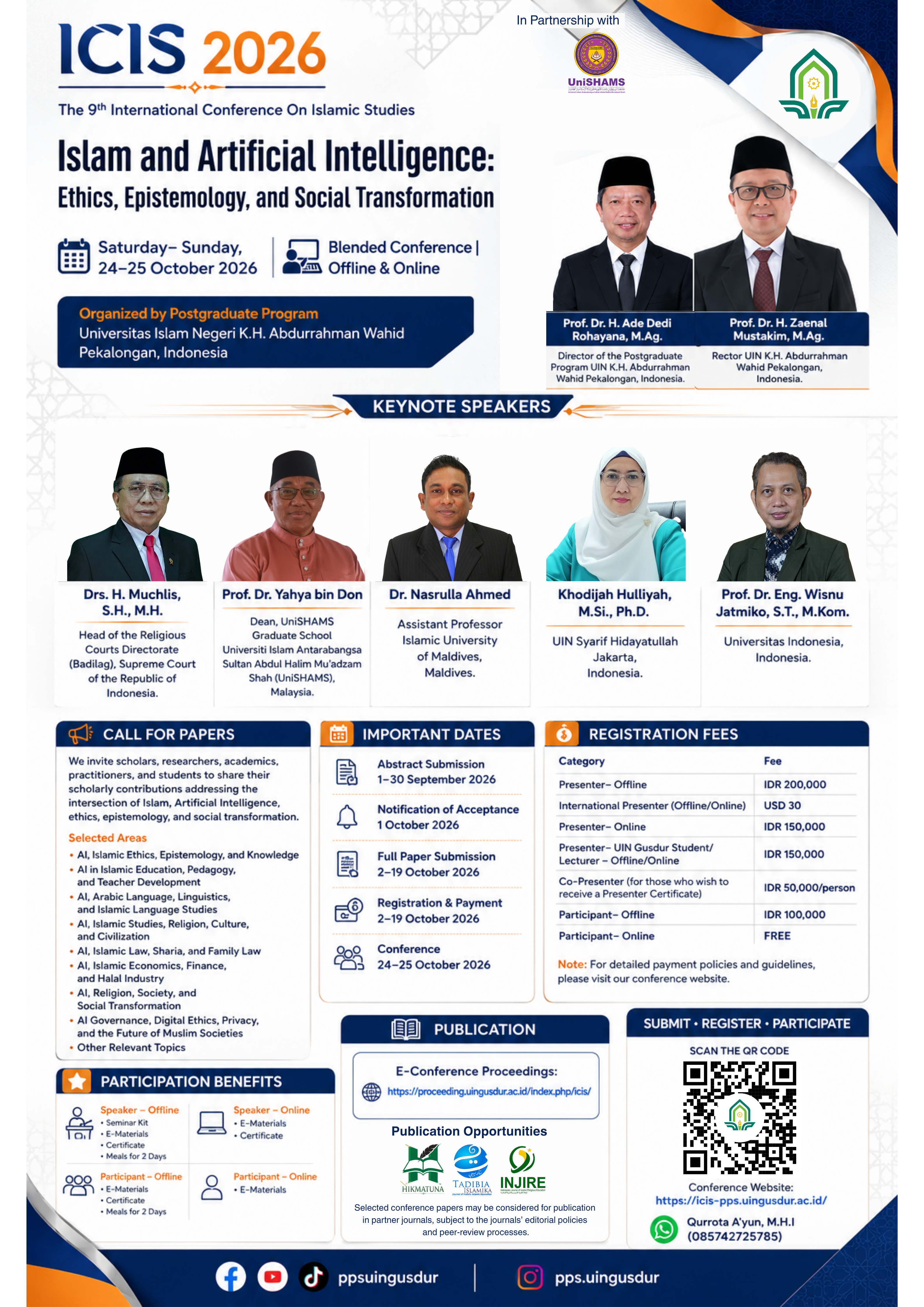
Reconstructing Islamic Moral Education in The Age of Artificial Intelligence: An Integration of Taqwa, Qalb, and Artificial Moral Reasoning
Keywords:
islamic religious education, generative ai, authentic assessment, source verification, academic integrityAbstract
The rapid development of artificial intelligence (AI) has transformed educational practices, knowledge production, and moral decision-making, raising fundamental questions about the role of moral education in shaping responsible human agency. In Islamic education, these developments highlight the need to reconsider the foundations of moral formation beyond technological literacy and cognitive competence. This study aims to reconstruct an Islamic moral education framework by integrating the concepts of taqwa, qalb, and artificial moral reasoning to address emerging ethical challenges in the age of AI. Employing a qualitative library research method, this study adopts a philosophical and conceptual approach through critical analysis of classical Islamic scholarship, particularly the moral thought of Al-Ghazali, alongside contemporary literature on AI ethics, moral cognition, and educational philosophy. The findings suggest that taqwa can be understood as a foundational moral orientation that guides ethical judgment and responsible action, while qalb represents the spiritual and moral center of human consciousness in Islamic thought. Artificial moral reasoning, meanwhile, provides a contemporary framework for examining how AI-mediated environments influence ethical reflection and decision-making. Integrating these concepts offers a framework in which technological competence is complemented by spiritual awareness, moral discernment, and ethical responsibility. This study concludes that Islamic moral education in the age of AI should not merely focus on the effective use of technology but also cultivate taqwa, strengthen moral consciousness, and preserve human agency. The proposed framework contributes to contemporary discussions on Islamic education by positioning spiritual and ethical formation as essential foundations for navigating technological transformation.