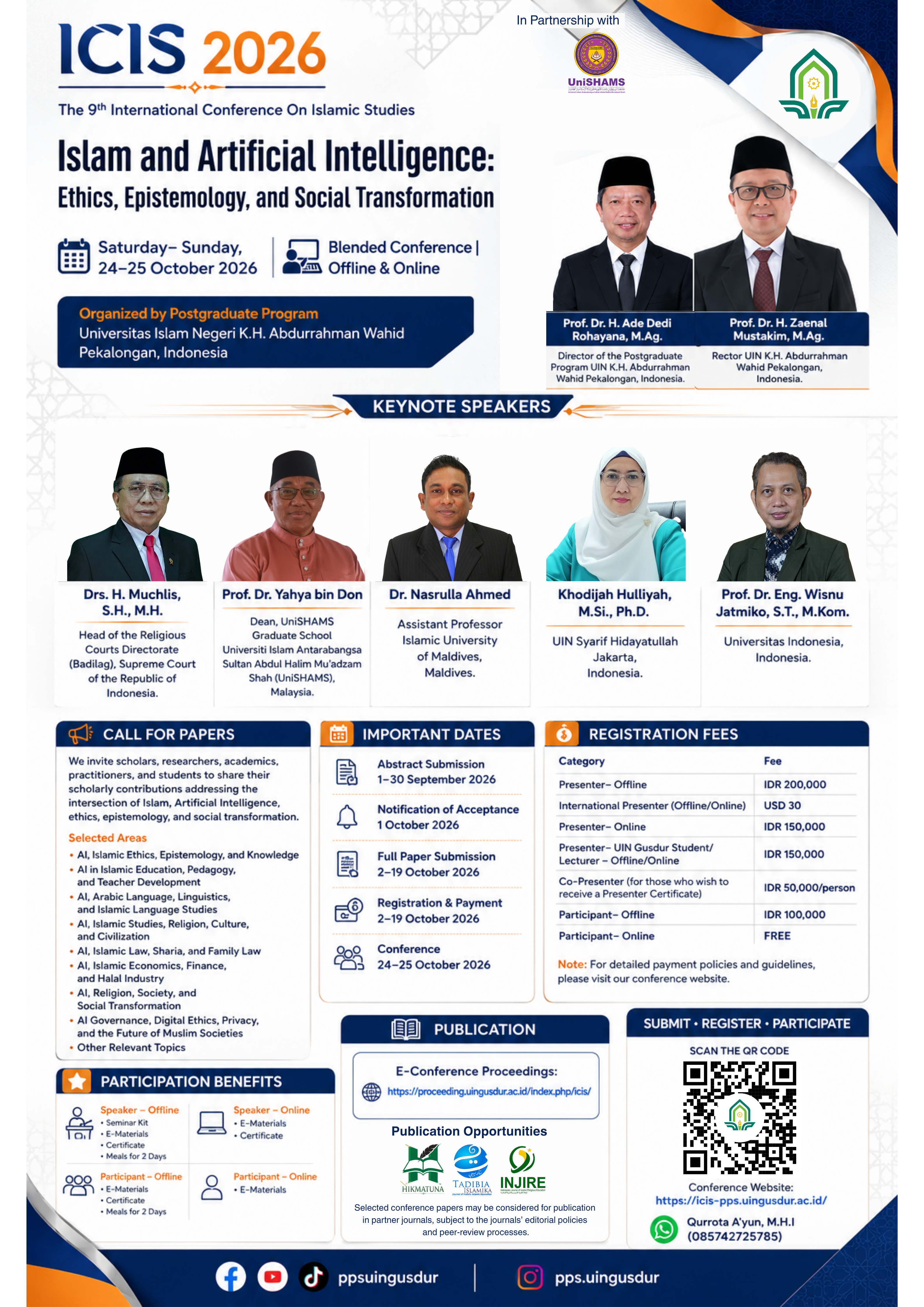
From Amanah to Algorithms: Islamic Ethical and Epistemic Foundations for Value-Based AI Literacy in Primary Education
Keywords:
Artificial Intelligence, Islamic Ethics, Islamic Epistemology, social transformation, islamic educationAbstract
The rapid expansion of artificial intelligence (AI) challenges Islamic thought and Islamic education to articulate ethical, epistemic, and social responses grounded in revelation and scholarly tradition. In Indonesia, where Coding and Artificial Intelligence has been introduced as an elective subject from grade 5 of primary school, the question is pressing, yet existing studies usually address ethics, religious authority, or pedagogy separately. This study describes and analyzes how ethics, epistemology, and social transformation are represented in scholarship and policy on AI from an Islamic perspective, and draws implications for Islamic education. Using a qualitative content analysis with hermeneutic interpretation, the data comprised scholarship on AI ethics and technology, works on Islamic ethics and epistemology, and policy documents, including the UNESCO Recommendation on the Ethics of Artificial Intelligence and Indonesian instruments. The ethical dimension is the most developed, whereas the epistemological and educational dimensions are treated unevenly and rarely connected to concepts such as amanah, 'adl, 'ilm, tabayyun, and sanad. The study concludes that these concepts support an integrated framework in which accountability remains with human agents, machine-generated knowledge is verified, and social benefit is pursued. The findings offer a theoretical basis for an Islamic paradigm of AI and for reflective, value-based AI literacy in Islamic education.